The Aesop for Children by Milo Winter
The Animals and the Plague
Once upon a time a severe
plague raged among the animals.
Many died, and those who lived
were so ill, that they cared for
neither food nor drink, and
dragged themselves about listlessly. No longer could a fat
young hen tempt Master Fox to
dinner, nor a tender lamb rouse
greedy Sir Wolf's appetite.
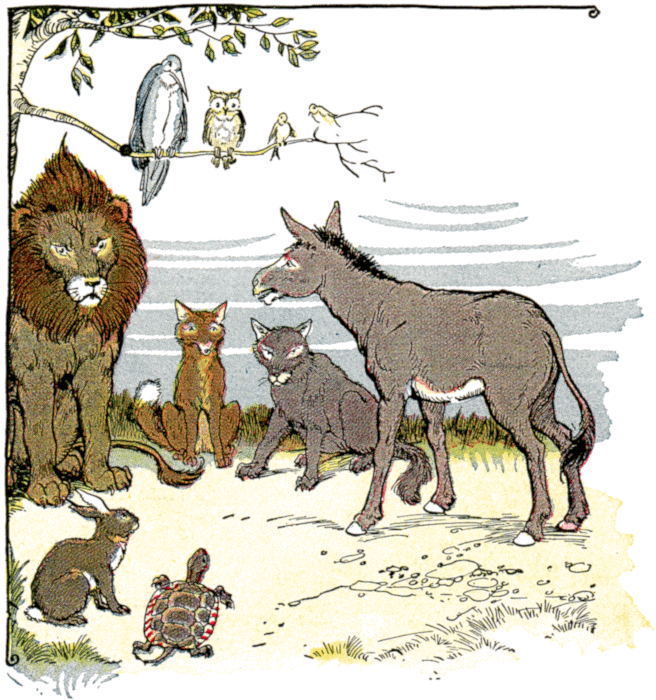
At last the Lion decided to call
a council. When all the animals
were gathered together he arose
and said
"Dear friends, I believe the
gods have sent this plague upon
us as a punishment for our sins.
Therefore, the most guilty one
of us must be offered in sacrifice.
Perhaps we may thus obtain
forgiveness and cure for all.
"I will confess all my sins
first. I admit that I have been
very greedy and have devoured
many sheep. They had done me
no harm. I have eaten goats and
bulls and stags. To tell the
truth, I even ate up a shepherd
now and then.
"Now, if I am the most guilty,
I am ready to be sacrificed. But
I think it best that each one confess
his sins as I have done. Then
we can decide in all justice who is
the most guilty."
"Your majesty," said the Fox,
"you are too good. Can it be a
crime to eat sheep, such stupid
mutton heads? No, no, your
majesty. You have done them
great honor by eating them up.
"And so far as shepherds are
concerned, we all know they
belong to that puny race that
pretends to be our masters."
All the animals applauded
the Fox loudly. Then, though the
Tiger, the Bear, the Wolf, and
all the savage beasts recited the
most wicked deeds, all were
excused and made to appear
very saint-like and innocent.
It was now the Ass's turn to
confess.
"I remember," he said guiltily, `"that one day as I was passing
a field belonging to some priests,
I was so tempted by the tender
grass and my hunger, that I could
not resist nibbling a bit of it. I
had no right to do it, I admit—"
A great uproar among the
beasts interrupted him. Here was
the culprit who had brought misfortune on all of them! What a
horrible crime it was to eat grass
that belonged to someone else! It
was enough to hang anyone for,
much more an Ass.
Immediately they all fell upon
him, the Wolf in the lead, and
soon had made an end to him,
sacrificing him to the gods then
and there, and without the formality of an altar.
The weak are made to suffer for the misdeeds of the powerful. |